I was born in Lisbon in 1966, in a city where history doesn’t sit quietly in books—it lives in the streets, in the light on the buildings, in the worn stones people walk over without thinking twice. Growing up there, it was impossible not to feel that the past was somehow still present. That feeling stayed with me. It made me curious - not just about history itself, but about people: how they think, how they act, and how their ideas shape the world around them.
That curiosity slowly turned into a habit of reading and exploring, especially the restless and transformative 19th and 20th centuries. As a Portuguese, I also grew up with the legacy of the Discoveries - the idea that leaving is part of who we are. The desire to explore the unknown, paired with a deep attachment to where we come from. These feelings that we all share have always fascinated me, and it has mirrored my own path.
Alongside this broader interest in History, I found myself drawn to something more personal: my own family’s history. Over the years, I’ve spent time building our family tree, collecting fragments of memory, stories told and retold, and trying to give them some permanence. It’s a quiet kind of work, but meaningful - like connecting small pieces of a much larger puzzle, not just for myself, but for those who come after.
Travel added another layer to all of this. Visiting Central and Eastern Europe, and countries like Bosnia and Hercegovina, Morocco and Türkiye, gave me something books alone never could: a lived sense of History and culture. You begin to notice how deeply the past shapes everyday life - how it shows up in habits, conversations, even in the way cities breathe. It’s one thing to understand History intellectually; it’s another to walk through it, to feel it around you.
At some point during High School, this interest in people and their behavior led me to study Human Resources Management and Labour Psychology at Universidade Europeia. It was a natural extension of my curiosity - an opportunity to better understand what motivates us, how we connect, and how relationships take shape within groups and organizations. In a way, it brought a more structured perspective to questions I had been asking for years.
Life, however, rarely follows a straight line. Eventually, it took me away from Portugal and brought me to Belgium. What began as a significant change - one that came with its share of uncertainty - gradually became something permanent. Adapting to a new country, a different culture, and a new rhythm of life wasn’t easy, but it was undeniably enriching. Over time, Belgium became home. Becoming a Belgian citizen didn’t feel like replacing one identity with another, but rather adding a new layer to it - something that reflects the path I’ve taken.
Languages played an essential role in that transition. Portuguese will always be my first language, but learning and living in Dutch, French and English opened new doors. Each language carries its own way of seeing the world - its own humor, its own subtleties. Switching between them is not just practical; it’s a way of moving between different perspectives, of understanding people more fully. It has helped me feel at home in places that once felt unfamiliar.
My family is at the center of my life. I am a husband, a father of five, and a grandfather of three - which means life is full, dynamic, and rarely quiet. Our family is spread across several countries - Portugal, Belgium, Latvia, Germany, France, Italy, Brazil, the United States, Mexico and Senegal. Because of that, diversity is not an abstract idea for us; it’s part of everyday life. It’s present in the conversations we have, the traditions we share, and the different ways we see the world. Those moments - simple, ordinary, and sometimes chaotic - are the ones I value most.
Professionally, I work with Windows environment, but at home my preference goes to Linux. It’s a small detail, but in a way it reflects something broader: an appreciation for flexibility, openness, and understanding how things work beneath the surface. I’ve always been drawn to that - whether in technology, in history, or in people.
Looking back, what stands out is not a single path, but the connections along the way. Between countries and cultures, between languages and ideas, between generations of a family. All of these threads have shaped how I see the world and what I value: curiosity, respect, and the willingness to truly listen. In the end, it’s those connections that give meaning to everything else.
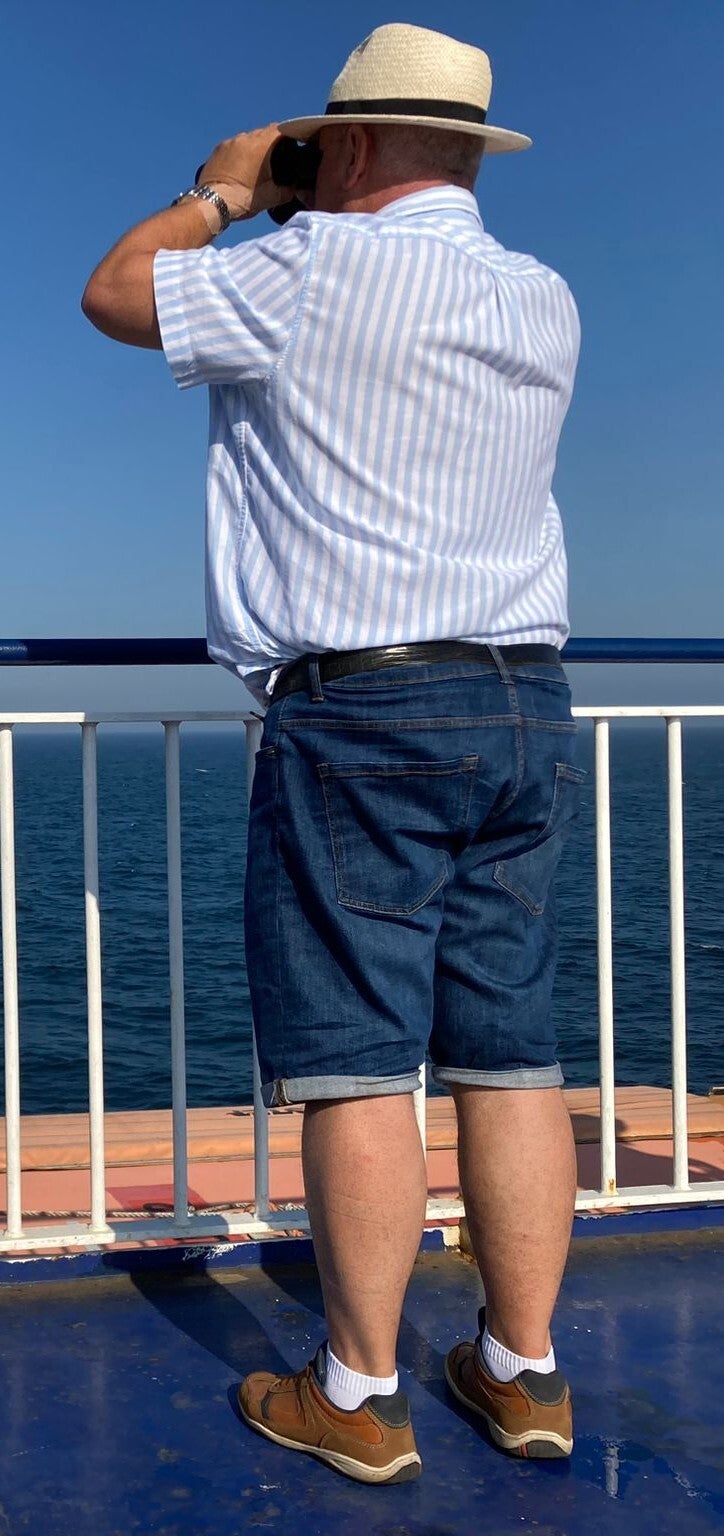
Picture taken in September 2024 while crossing the Baltic Sea
Visited countries

Maak jouw eigen website met JouwWeb